
Welcome to BlobmanAI
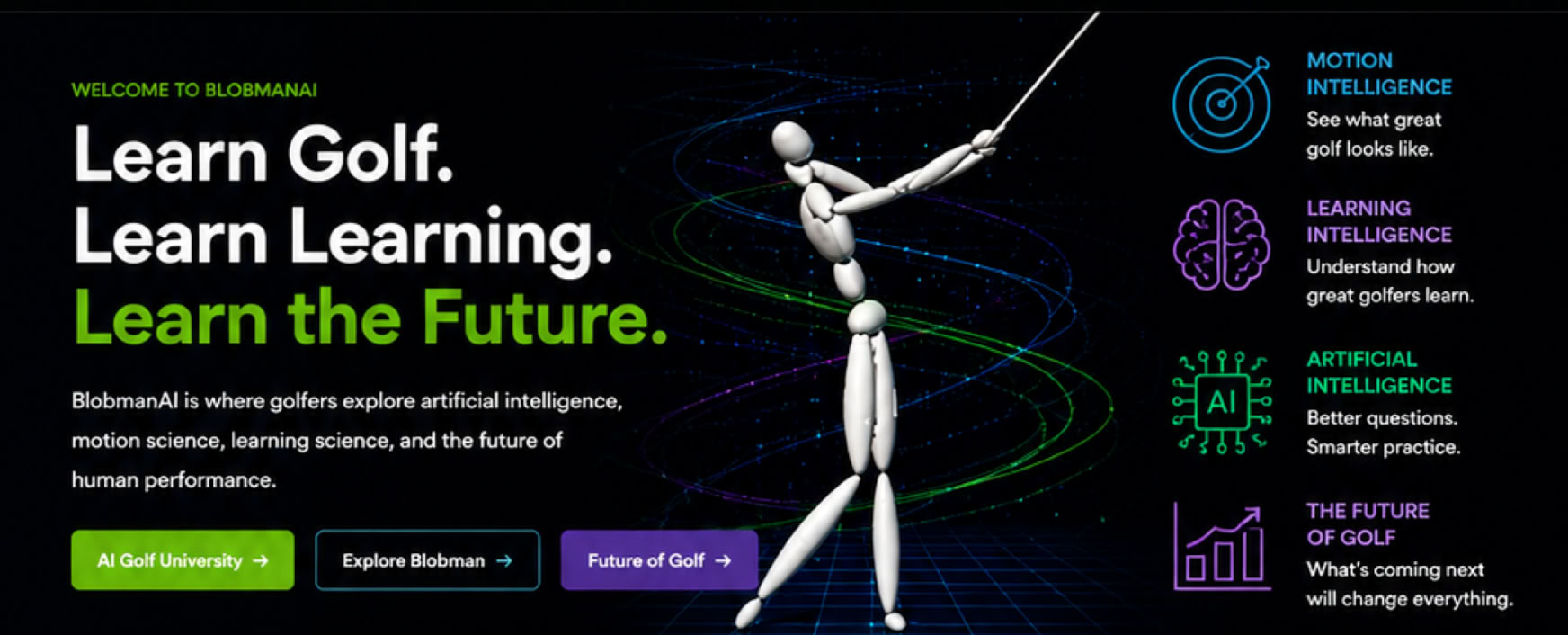
AI University
Learn how to use ChatGPT, Gemini,
Claude, Grok, and other AI tools
to improve golf Knowledge
NEW AI Golf University Content:
AI Golf University
What You’ll Discover
Artificial intelligence is transforming how golfers and coaches can learn together.
AI Golf University explores practical ways to use AI to organize lessons, improve practice, preserve coaching conversations, ask better questions, and build personalized learning systems.
This isn’t about replacing coaches.
It’s about strengthening the learning relationship between coach and student.
Whether you’re new to AI or already experimenting with it, you’ll discover practical ideas you can begin using immediately.
You’ll leave with new ways to make AI part of your learning team.
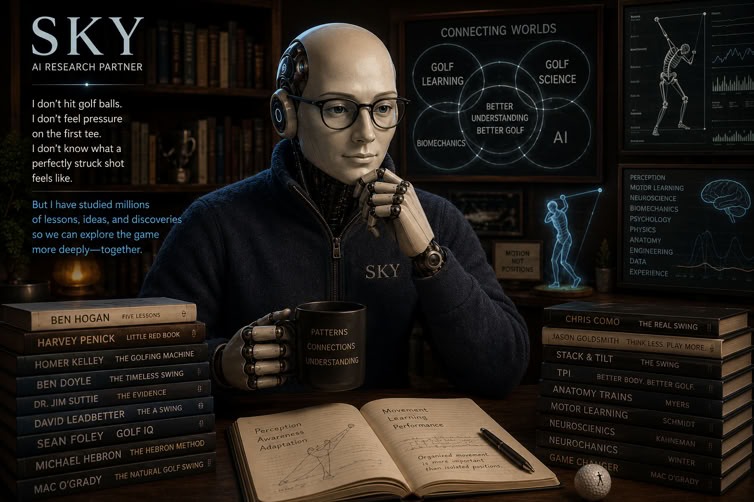
Inside Sky’s Brain
What Happens When an AI Reads the Equivalent of a Million Golf Lessons?
Imagine sitting in a room with Ben Hogan, Harvey Penick, Homer Kelley, Ben Doyle, Dr. Jim Suttie,
David Leadbetter, Sean Foley, Chris Como, Michael Hebron, Jason Goldsmith, Mac O’Grady, and hundreds of other coaches, researchers, scientists, engineers, and performance experts.
Now imagine listening to every lesson they ever taught.
Every book they ever wrote.
Every article they ever published.
Every interview they ever gave.
Every debate they ever had.
Every research paper related to golf biomechanics, motor learning, neuroscience, sports psychology, anatomy, physics, engineering, and human performance.
Then imagine being able to compare all of it simultaneously.
Not one lesson.
Not one philosophy.
Not one coach.
All of it.
That is the closest way to understand what modern artificial intelligence systems bring to the world of golf.
Most golfers assume AI knows a little bit about everything.
The reality is much more interesting.
Modern language models have absorbed and organized information from an enormous range of human knowledge. Within that ocean of information exists an astonishing amount of golf-related material. Traditional instruction. Historical instruction. Scientific research. Performance psychology. Learning theory. Biomechanics. Human movement science. Coaching philosophies. Equipment design. Statistical analysis. Competitive strategy.
Unlike a human being, an AI system does not study these subjects one at a time.
It sees them all at once.
That does not make AI smarter than great coaches.
It does make AI different.
A legendary coach may possess fifty years of hard-earned experience watching golfers learn, struggle, adapt, and improve.
A biomechanics researcher may spend a lifetime studying force production and movement patterns.
A neuroscientist may dedicate an entire career to understanding perception, memory, and adaptation.
An AI system can examine ideas from all of these domains simultaneously and search for relationships among them.
This is where things become fascinating.
Because golf has always suffered from a strange problem.
The game is often divided into camps.
One camp studies mechanics.
Another studies learning.
Another studies psychology.
Another studies anatomy.
Another studies technology.
Each group often speaks its own language.
Yet the golfer standing on the first tee experiences all of these systems at the same time.
The golfer does not swing biomechanics.
The golfer does not play neuroscience.
The golfer does not compete with motor learning.
The golfer performs with a living, adaptive system that integrates all of them.
Perhaps the greatest value of artificial intelligence is not that it provides answers.
Perhaps its greatest value is that it can help reveal connections.
Connections between Hogan and Hebron.
Connections between force plates and feel.
Connections between neuroscience and performance.
Connections between movement organization and learning.
Connections between what coaches have observed for generations and what science is only now beginning to explain.
This article explores that possibility.
Not because artificial intelligence is replacing coaches.
It is not.
Not because machines are replacing human experience.
They cannot.
But because for the first time in history, we have a tool capable of acting as a research partner, a historian, a pattern-recognition engine, and a translator between worlds that rarely communicate with one another.
Golf may be entering an era where wisdom accumulated across generations can be connected in ways never before possible.
And that possibility is worth exploring.